
If you have requested a quote for Chinese solar panels recently and found prices higher than expected, you are not misreading the market. You are reading a policy decision.
On January 9, 2026, China’s Ministry of Finance and State Taxation Administration issued Announcement No. 2 of 2026, canceling the 9% export VAT rebate on photovoltaic products from April 1, 2026. For buyers who have been used to years of declining solar module prices, this is not just a short-term price movement. It is a structural change.
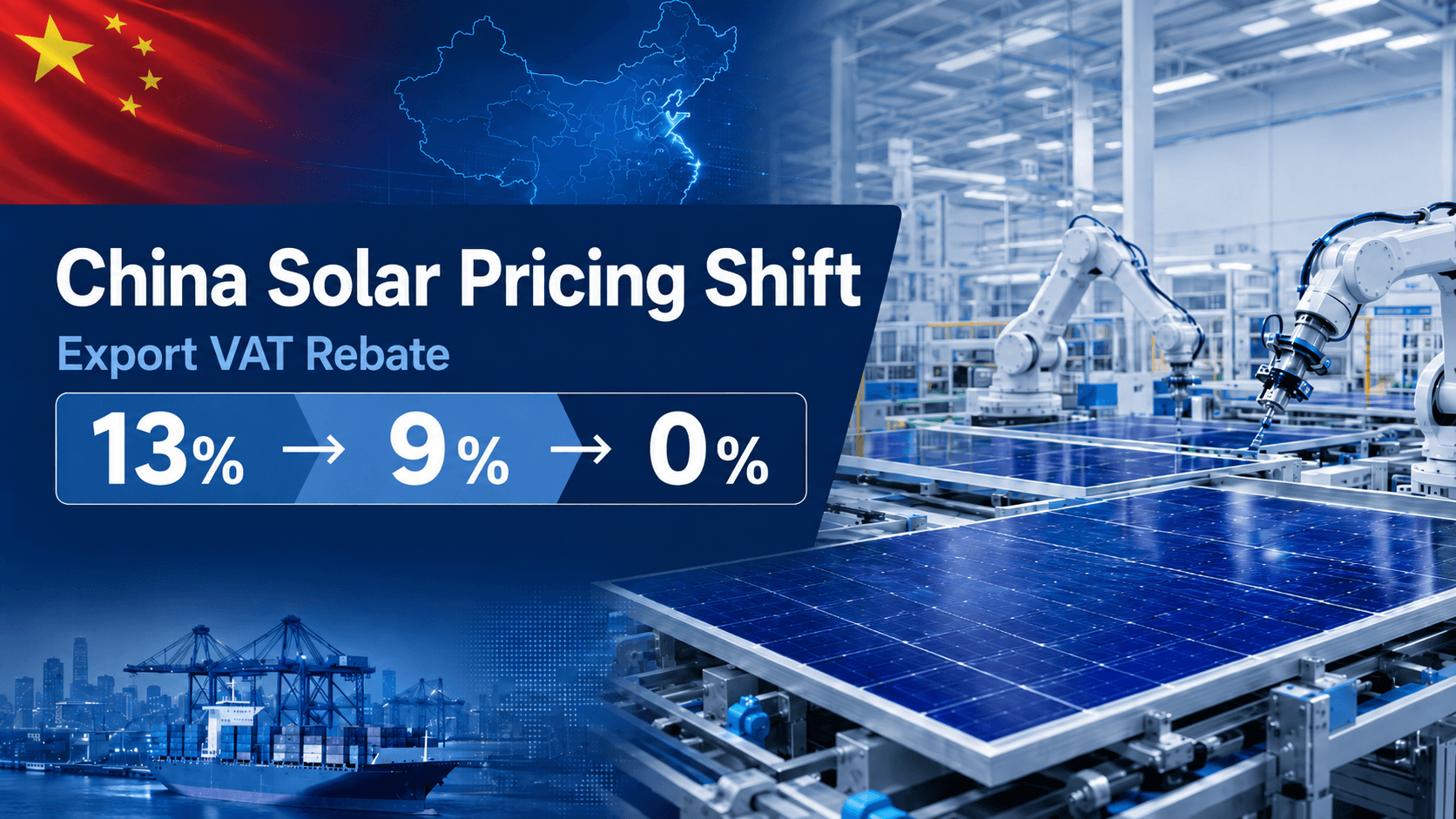
China’s export VAT rebate system allowed manufacturers to reclaim part of the VAT paid during production. For many years, solar module exporters received a 13% rebate. In December 2024, this was reduced to 9%. From April 2026, it becomes 0%.
What the Cancellation Actually Changes
The removal of the 9% rebate creates a direct, unrecoverable cost addition of approximately 9.9% on the manufacturer's cost base, which must either be absorbed by the supplier or passed to the buyer. Most of it will be passed to the buyer.
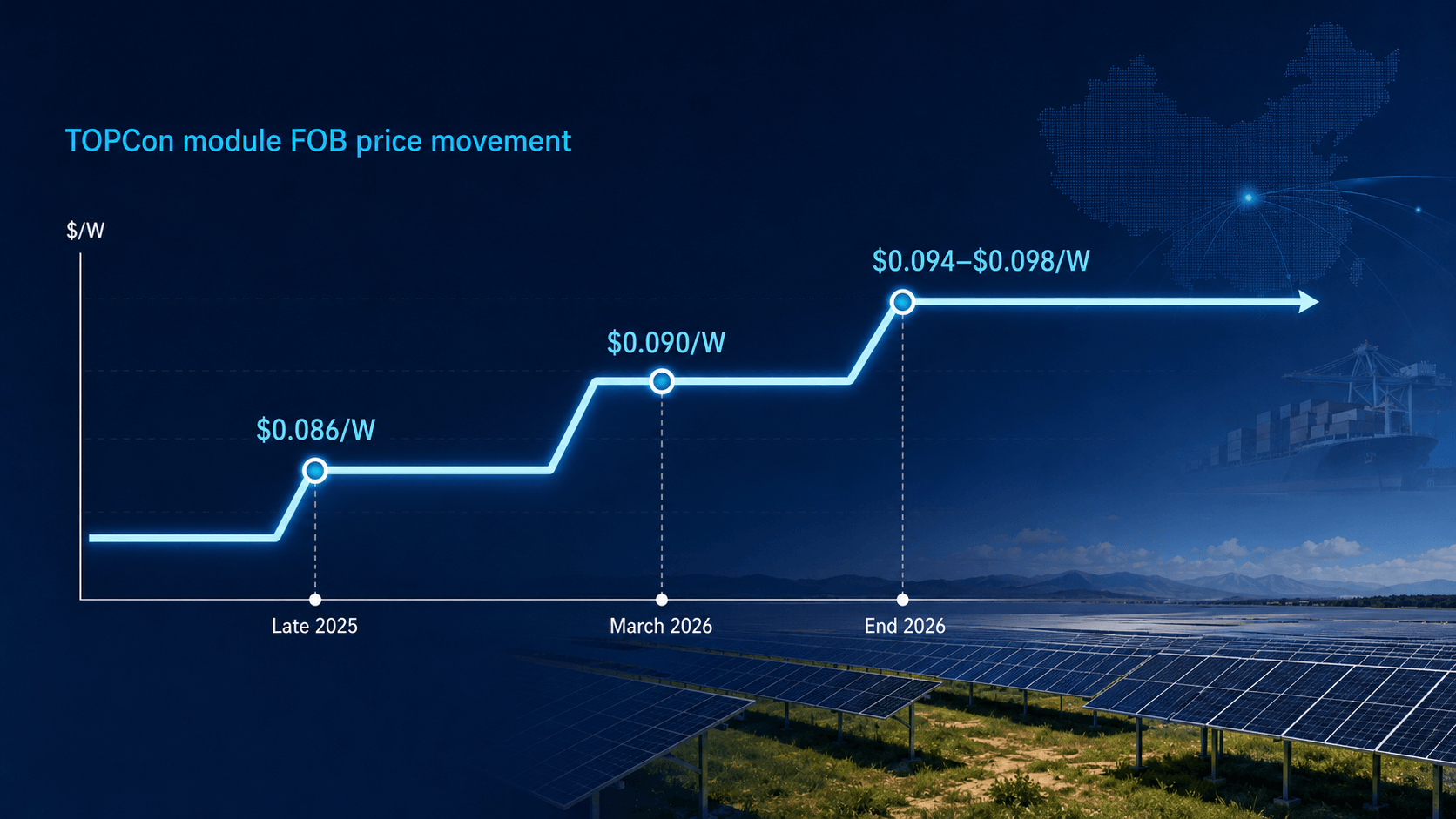
Leading manufacturers estimate the cancellation increases baseline production costs for solar modules by 0.06 to 0.07 yuan per watt. FOB prices for TOPCon modules, which stood around $0.086 per watt in late 2025, rose to approximately $0.090 in March 2026 on pre-deadline buying and are projected to stabilize between $0.094 and $0.098 per watt by end of 2026. This is not temporary. It is a permanent repricing of Chinese solar exports.
Not All Suppliers Are Equally Affected
Tier 1 manufacturers, with fully integrated supply chains, advanced technology portfolios, and production committed months ahead, are positioned to pass the cost increase through while maintaining their commercial relationships. Many are already holding FOB quotations at 0.80 to 0.85 yuan per watt.
Tier 2 and Tier 3 suppliers face a different reality. Operating on thinner margins, many have been pricing around 0.78 yuan per watt to preserve volume, absorbing a portion of the rebate loss. This delays the problem rather than solving it.
The consequence for buyers is concrete. A manufacturer under financial pressure is more likely to delay shipments, substitute production inputs, or reduce quality oversight to protect margins. More critically, solar module warranties run 25 to 30 years. If a lower-tier supplier exits the market within the next several years, the warranty becomes unenforceable. The top five module manufacturers already controlled 64% of global capacity by the end of 2025. The rebate cancellation is accelerating consolidation, and not all current suppliers will still be operating when a warranty claim is needed.
The Battery Sector: A Second Deadline Approaching
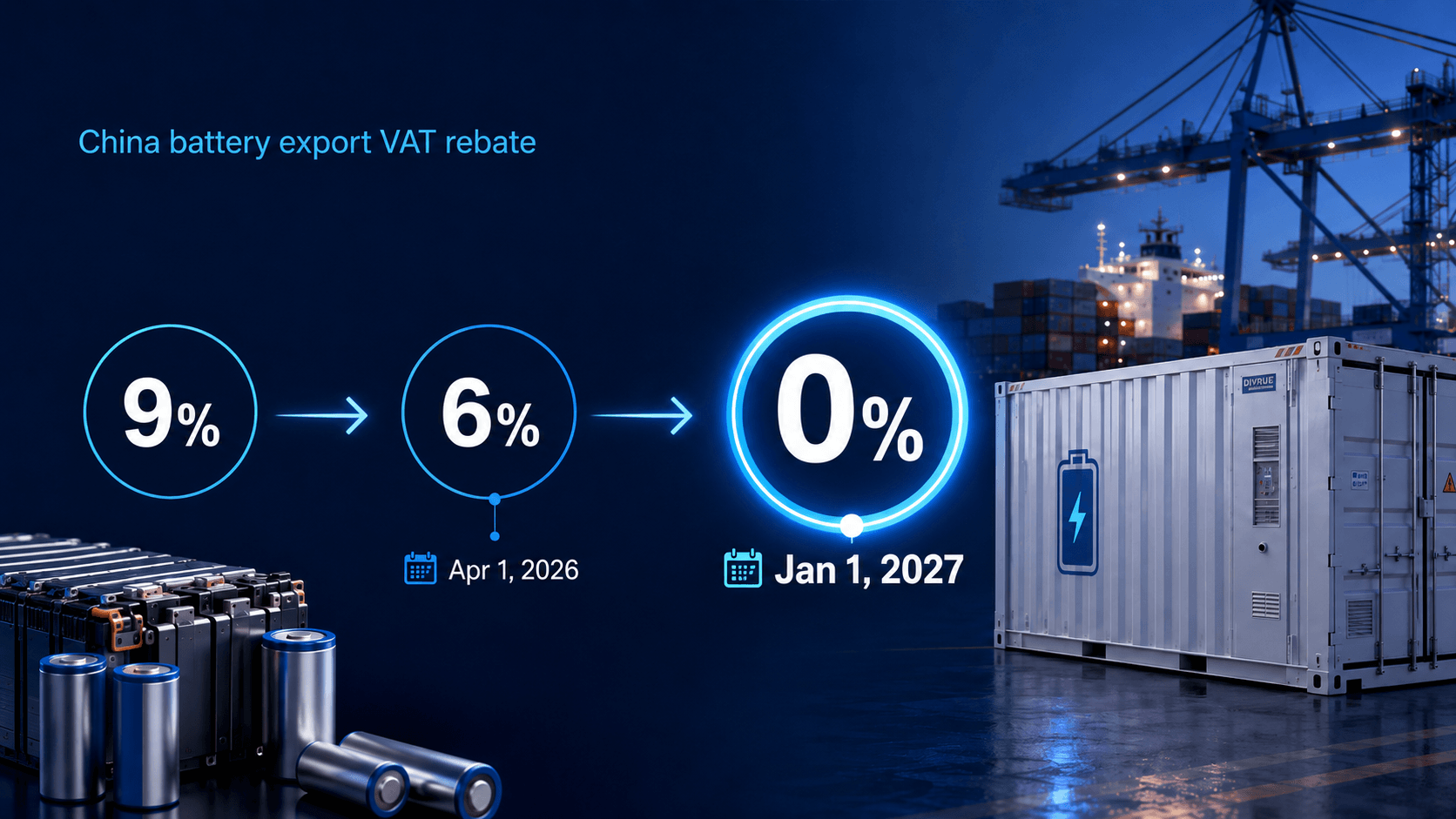
Buyers sourcing battery cells, modules, or energy storage systems from China face the same direction of travel on a different timeline. The January 2026 announcement reduced the export VAT rebate on battery products from 9% to 6%, effective April 1, 2026, with full elimination following on January 1, 2027.
A transitional window remains, but it closes at year-end. The logistical pressure seen in March 2026, when Chinese cleantech exports surged 70% year-on-year and port congestion at Shanghai and Ningbo extended processing times by 7 to 14 days, is a preview of what the December 2026 deadline may produce. Buyers planning battery or energy storage procurement should factor this into their timelines now, not in the fourth quarter.
Procurement Contracts: A Detail That Now Matters
As costs rise across the solar and battery supply chain, the commercial and legal structure of procurement agreements deserves closer attention. Contracts executed after January 2026 should explicitly state whether agreed prices are inclusive of the VAT rebate adjustment. Without this clarity, suppliers retain grounds to claim cost increases on agreements signed before the official announcement, citing changes in applicable law. This has already disrupted several large-scale project timelines in early 2026. Any project that has not yet committed to a construction schedule should update its financial model to reflect the new equipment cost baseline first.
What We Pay Attention to at FortuneSix
The Chinese energy sector supply chain is not static. Policy decisions, raw material cycles, manufacturer financial health, and technology shifts all affect what a quote actually means at any given moment.
When we work on solar or battery component sourcing, we look beyond the line price. We evaluate supplier tier and financial position, how quoting behavior responds to policy and commodity shifts, and what contractual protections are in place. A price that appears competitive in isolation can carry risk that a single quote cannot reveal.
If you are planning solar or battery procurement from China and want a clearer picture of what you are actually buying,