
The Fastest Supplier in Your Inbox May Be the Wrong One
One of the most expensive habits in sourcing is rewarding speed too early.
A supplier replies in ten minutes, sends a price the same day, and sounds ready to move. For many buyers, that creates instant confidence. The supplier looks active, hungry, and professional.
In China sourcing, that first impression can be badly misleading.
Fast replies are easy to produce. Reliable execution is not.

Why Speed Can Be a False Signal
Buyers naturally notice speed because it is visible.
It makes the supplier seem organized and serious. In a busy sourcing process, that kind of responsiveness can be very persuasive.
But speed is not the same as control.
The real question is not who answers first. The real question is who actually understands the request, controls the process behind the quote, and can keep the project stable once the order starts moving.
Those are very different things.
A quick reply can win the inquiry. It does not guarantee the supplier can carry the order.
Fast Replies Often Come from Sales, Not Production
This is where China sourcing requires a sharper eye.
A fast reply does not always come from the factory. It often comes from the party farthest from production and closest to the sale.
That party may be a trader, a middleman, a commission-based intermediary, or simply a sales contact with limited visibility into what is actually happening on the production floor. They can sound confident, flexible, and highly responsive in the early stage because their job is to win attention first.
But once the discussion moves beyond the first quote, the gap starts to show.
The buyer asks for technical clarification. The timeline needs to be confirmed. Packaging details matter. Sample conditions change. Production realities start replacing sales language.
This is where fast early communication can turn into slow, fragmented, and unreliable execution.
The issue is not that intermediaries are always bad. The issue is that buyers often mistake sales speed for operational strength.

What Fast Replies Often Hide
Some suppliers reply quickly because they are genuinely well organized.
Others reply quickly because they are too quick to say yes.
That difference matters.
Fast replies often hide problems such as:
quoting before the brief is fully understood
prices shared before key assumptions are confirmed
commercial terms left vague until later
lead times that sound attractive but are not properly aligned with production
sales teams moving faster than the factory behind them
weak control once the project becomes more detailed
None of this may be obvious in the first message. That is why it catches buyers off guard.
The Hidden Cost of the Wrong “Yes”
In sourcing, the first yes is sometimes the beginning of the real problem.
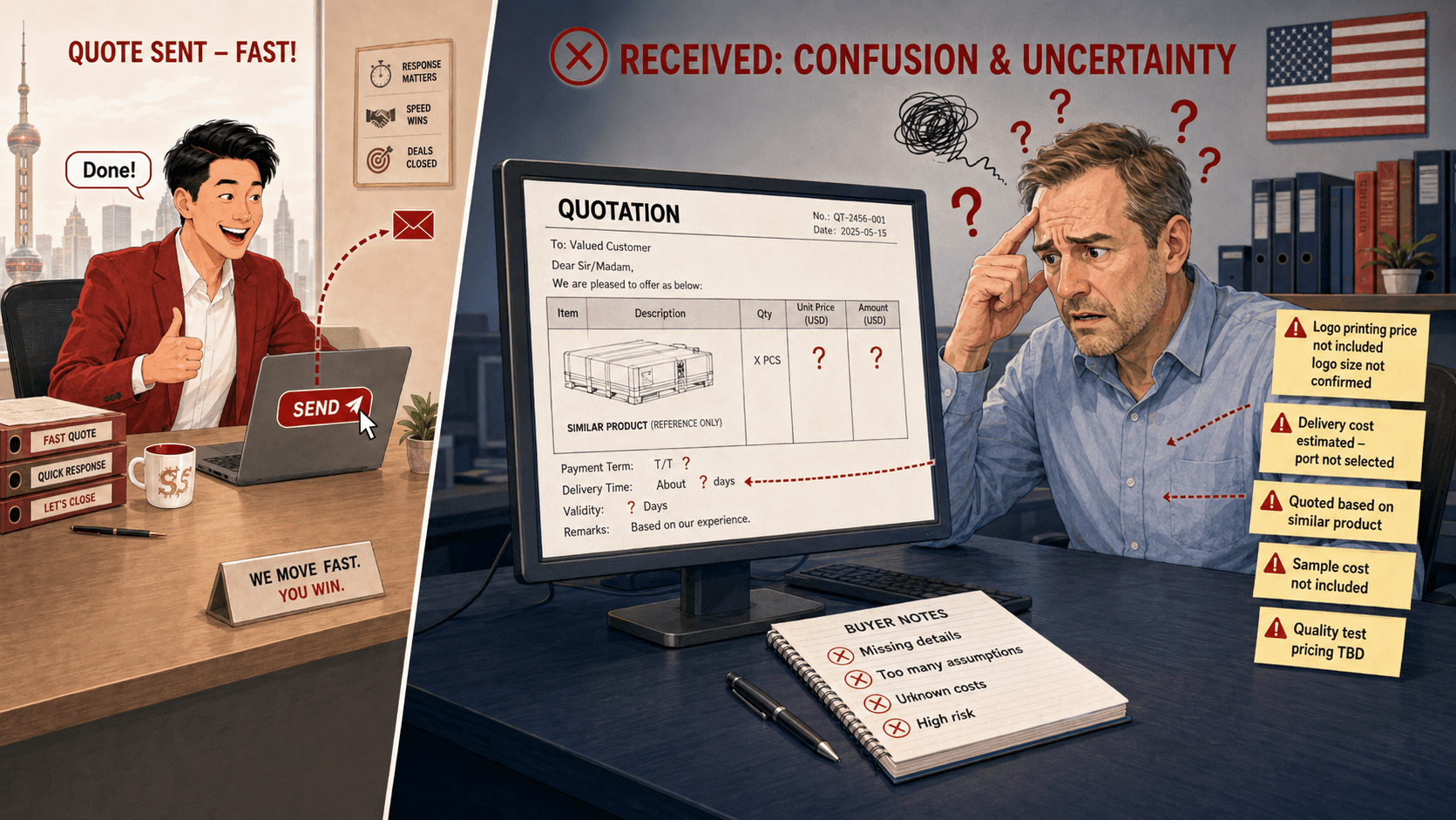
A supplier who says yes too quickly can create a false sense of readiness. The buyer thinks the project is moving. In reality, important parts of the project may still be floating.
That hidden cost usually appears in familiar ways:
repeated clarification after the quotation stage
corrections that could have been avoided
sample and timing confusion
more manual chasing from the buyer side
weaker confidence as the project gets closer to production
Sometimes the fastest supplier simply gives the buyer more work later.
What a Stronger Supplier Does Instead
A stronger supplier does not only reply fast. A stronger supplier replies with control.
That usually shows up in a few very specific ways.
They ask better questions before they quote. They push for missing details instead of hiding them. They make their assumptions clear. They are less eager to impress with speed and more focused on preventing confusion later.
Their communication often feels calmer, but stronger.
They may not always be the first to answer. But when they do answer, the reply reduces uncertainty instead of creating more of it.
That difference is easy to miss if the buyer is only rewarding speed.
In sourcing, a quick answer can save an hour. A clear answer can save weeks.
What We Do at FortuneSix
At FortuneSix, we do not treat speed as proof of strength.
Responsiveness matters, of course. But a fast reply only helps if it reflects real understanding, real alignment, and real execution discipline.
That is what we pay attention to.
We look at whether the supplier understood the requirement properly, whether the quotation is commercially usable, whether the assumptions are clear, whether the timeline feels planned rather than attractive, and whether the process behind the reply feels connected to actual production.
In other words, we do not just check how quickly the supplier replied.
We value what the reply reveals about how the supplier actually operates.
That tells us far more than response time ever could.
Because in the end, the buyer does not need the fastest reply. The buyer needs the strongest process behind the order.

A Better Way to Judge Early Signals
Early supplier signals matter. But they need to be read correctly:
Is this reply coming from someone who really understands production?
Is the supplier reducing uncertainty or just moving quickly?
Does the quote feel grounded in real execution, or mainly in sales confidence?
If the project becomes more complex tomorrow, will this process become clearer or heavier?
That is how better sourcing decisions get made.
Not by rewarding the first reply, but by reading the quality behind it.
If you want to evaluate suppliers with more clarity and less execution risk,