
Chinese Solar Panels: Why Suppliers Don’t Share Prices
You reach out to a Chinese solar module or battery cell manufacturer. The website looks professional, the brand is recognizable, and the product is exactly what your project requires. You ask for a price list. Nothing comes back or the response asks for details about your project before any number is shared. This is not evasion. It is how the top tier of China's solar and battery supply chain actually operates.
What Tier 1 Actually Means
Bloomberg New Energy Finance publishes a quarterly Tier 1 PV Module Makers list, qualifying manufacturers who have supplied own-brand modules financed through non-recourse debt from at least six different commercial banks within the preceding two years. The classification is financial rather than technical: Tier 1 status is a proxy for long-term solvency, assuring buyers that the manufacturer is likely to remain operational throughout the 25 to 30 year life of its product warranties.
Jinko Solar, LONGi, Trina Solar, and JA Solar lead global solar shipments at 60 to 90 GW annually. In batteries, CATL holds 39% of the global power battery market, BYD holds 16%. These are not companies competing for attention. They are companies allocating capacity. China's total solar manufacturing capacity stands at approximately 1,200 GW against global annual demand of around 650 GW. The top ten manufacturers maintain factory utilization rates of around 70%, compared to a sector-wide average of 43%. The strongest players are selective by design.

Why They Will Not Quote You Directly
Tier 1 manufacturers do not publish price lists because no standard price exists. Every quote is a calculated output of the specific bill of materials, current raw material spot prices, trade compliance requirements of the destination market, and the financing structure behind the purchase. A standardized catalog is commercially unworkable under these conditions.
Beyond pricing, direct procurement requires minimum order quantities of several megawatts for solar modules or several megawatt-hours for battery systems. Production capacity is committed months in advance through long-term agreements with utility-scale developers and state-backed enterprises. Manufacturers prioritize buyers with documented institutional project financing, since those transactions contribute to the bankability metrics on which Tier 1 classification depends.
A dense intermediary layer exists to fill this gap: authorized distributors, regional representatives, and EPC firms who aggregate demand, absorb compliance risk, and offer more accessible terms. Not all are who they claim to be. Roughly 50% of online listings presenting as direct factories are trading companies with no manufacturing capacity of their own. Some offer an unsustainably low initial quote to secure a deposit, then raise the price before shipping, citing raw material movements or policy changes.
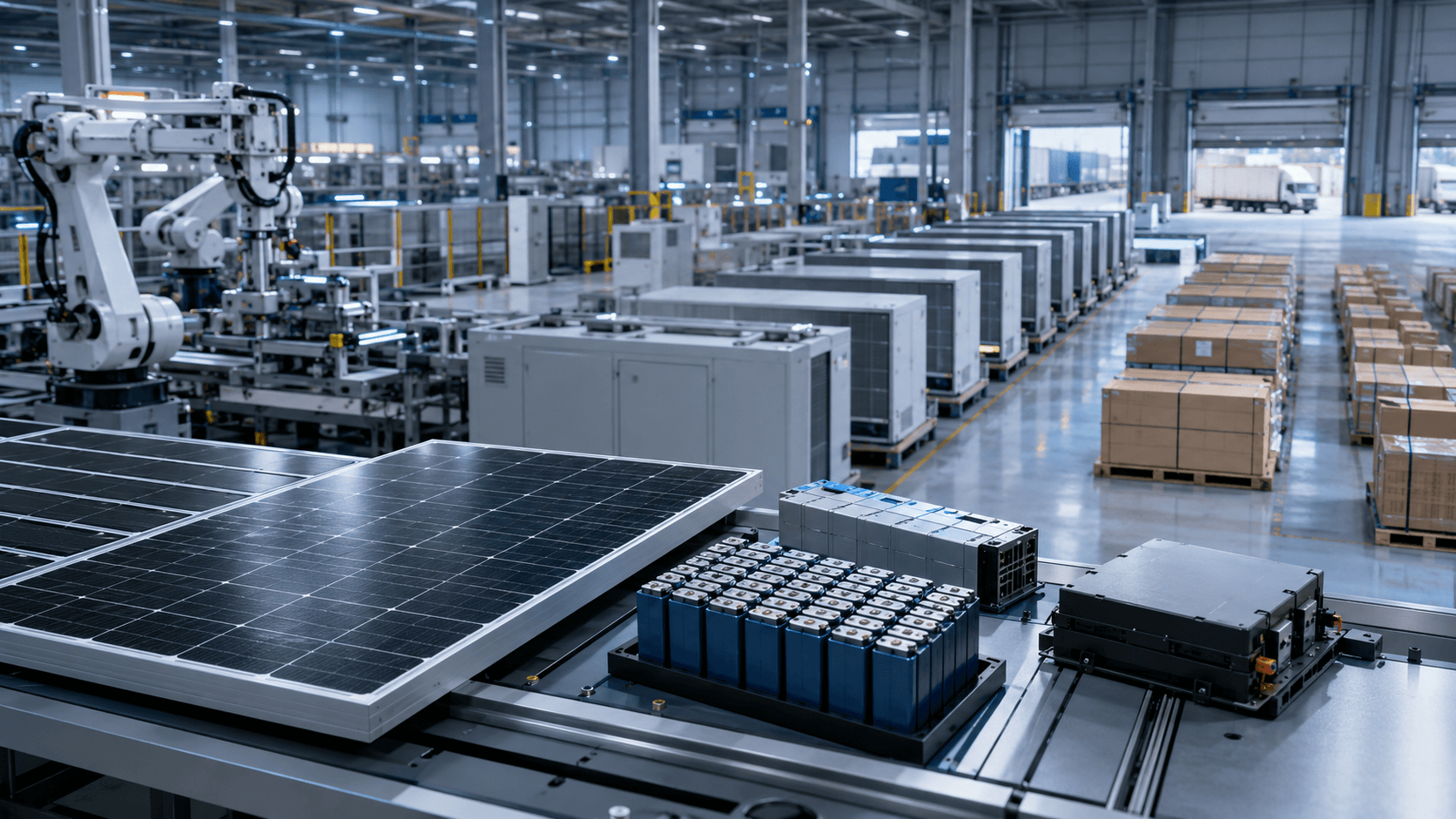
When the Market Goes Silent
Even buyers who approach with clear project requirements sometimes encounter a different problem: the supplier refuses to quote at all, or places a 24 to 48 hour validity window on any number shared.
In the battery sector, lithium carbonate volatility is the primary driver. As the key input for both LFP and NCM cathode materials, it represents 30 to 40% of a battery cell's total bill of materials cost. Spot prices in China reached nearly CNY 600,000 per tonne in 2022, collapsed by more than 80% to below CNY 100,000 by late 2024, and rebounded to CNY 200,500 per tonne by May 2026, driven by supply disruptions and manufacturing demand ahead of the battery VAT rebate deadline. When a commodity constituting 40% of production cost moves by double-digit percentages within weeks, quoting a fixed forward price is not commercially viable. A supplier who goes quiet is not being obstructive; the inputs required to price your order are still in motion.
Buyers can track price direction independently. SMM (Shanghai Metals Market) publishes real-time lithium carbonate spot prices; Fastmarkets maintains a Battery Cost Index that models cell costs by chemistry. Neither replaces supplier engagement, but both make those conversations considerably more grounded.
Reading the Market Without a Price List
One approach that works is engaging authorized distributors and secondary resellers. These parties hold inventory, operate on more flexible commercial terms, and will quote more readily than manufacturers. Their prices are not factory prices, but the margin structure is consistent enough to work with. Authorized distributors typically operate at 5 to 15% above factory-gate pricing, with secondary resellers adding a further 10 to 20%. Working backward from a reseller quote through that cost stack gives a reasonable approximation of the underlying manufacturer FOB price.
One thing to bear in mind is that the calculation is only as reliable as the reference product it is applied to. Resellers often hold previous-generation equipment, and the generation gap with current Tier 1 production can be wide enough to make the comparison misleading.
As Tier 1 manufacturers upgrade production lines to newer technology generations, previous-generation products move into secondary distribution at discounts of 30 to 50% relative to current equivalents. For buyers with less stringent specifications or smaller project scales, this channel can offer real value. The tradeoff is warranty coverage: factory warranties are typically voided when products move through unauthorized secondary channels.
What We Pay Attention to at FortuneSix
The companies most willing to respond quickly with a price are not always the companies best positioned to deliver. Tier 1 manufacturers are selective precisely because they can afford to be. Quoting volatility is often a signal worth reading, not a friction to work around.
When we support clients in this sector, we engage across the full channel structure: direct factory contact where project scale justifies it, distributor relationships for immediate availability, and reseller analysis as a pricing benchmark. We track raw material indices, verify supplier status before engagement, and structure timelines around the supply chain's commercial realities, not against them.
If you are sourcing solar or battery components from China and want clearer visibility into what you are actually importing,